
Battle Overview
Combat in Scope is turn-based, tactical, and split into two phases. The soldier phase is where your party fights - three soldiers plus your avatar, on a formation grid, with skills and status effects and a live turn timeline. The boss phase is a one-on-one showdown between your avatar and the boss, auto-resolved with only basic attacks.
The Two-Phase Structure
Most fights in Scope end with a boss phase:
- Soldier phase - you control a party of soldiers + avatar in a tactical fight against enemy waves. Positioning, skills, charges, status effects.
- Boss phase - your avatar alone versus the boss. Auto-resolved, strict turn alternation, basic attacks only.
Not every combat surface uses both phases:
| Combat Mode | Soldier Phase | Boss Phase |
|---|---|---|
| Dungeons | Yes (multiple encounters) | Yes |
| Multi-phase adventure quests | Yes | Yes |
| Boss-only adventure quests | No | Yes |
| Arena | No | Yes (avatar vs avatar, no soldiers) |
Party, Position, and Turns
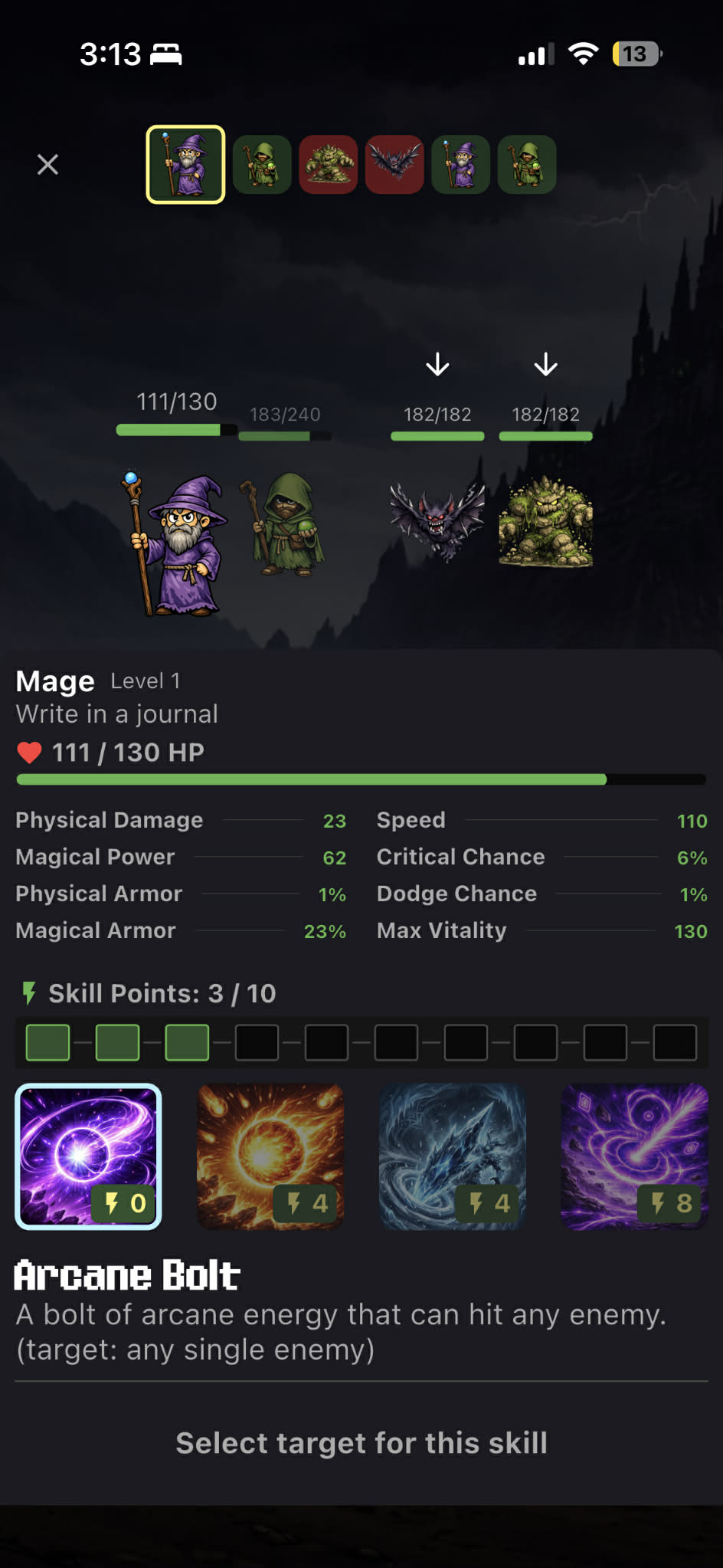
In the soldier phase, your party sits in a three-slot formation - front, middle, back. Each slot has different exposure to enemy attacks and different reach for your own skills.
Turns run on a charge-time battle system. There are no rounds - every unit has a personal countdown, and the unit whose countdown hits zero first acts next. Fast units act more often; slow units act less. Speed is the most strategically important stat in the game.
A live timeline strip shows the next several upcoming turns so you can plan.
What You Control Each Turn
When one of your units' turn arrives, you pick an action from their action bar:
- Basic attack - free, every unit has one.
- Use a skill - spends charges; targets per the skill's definition.
- Swap - trade position with an adjacent ally. Consumes the turn.
- Skip - pass without acting.
Any action ends the turn and triggers the unit's recovery - they reset their countdown based on their current Speed and wait to act again.
Damage Pipeline
When a hit lands, the damage math runs a fixed sequence:
- Raw damage from the attacker's Attack or Magic Power, times the skill's multiplier.
- Damage variance roll (small random factor).
- Defender's Armor or Magic Defense reduces the hit.
- Crit roll - on success, damage multiplied by the attacker's crit multiplier.
- Dodge roll - on success, damage becomes zero.
- Parry roll (Knights only) - on success, damage becomes zero.
- Active damage-reduction buffs apply (Shield Wall and friends).
- Minimum-damage floor - a hit that actually landed always does at least 1.
A dodged or parried hit completely negates the attack. Every other step is a partial reduction.
Winning and Losing
A battle ends the moment one side has no units left standing.
- Victory - all enemies defeated.
- Defeat - your whole party (soldier phase) or your avatar (boss phase) is wiped.
No turn limits, no draws, no fleeing from the soldier phase. You can forfeit explicitly from the UI if needed - it counts as a defeat.
No Mid-Dungeon Checkpoints
Multi-encounter content runs start to finish as one unit. If you lose encounter 3 of a 4-encounter dungeon, you restart from encounter 1. The design is deliberate - the whole run is supposed to feel like a single test, not a series of save points.
Between encounters in the same run, HP and status effects reset, but charges do too - each encounter is its own charge economy.