
Item Stats
Every item carries stats that boost your avatar's combat sheet when equipped. An item's stat numbers come from three layers: the template (what kind of stats this slot focuses on), the level (how big the overall stat budget is), and the rarity (how much the budget is amplified).
Base Stats vs Bonus Stats
An item's stats split into two categories:
- Base stats - the primary stats defined by the template. A weapon always has attack power (or magic power); a ring always has Luck-adjacent stats. These are the stats the item is meant to provide.
- Bonus stats - secondary stats rolled randomly from the pool of stats not covered by the template's primary emphasis. A weapon might roll a bonus Speed stat on top of its attack power.
Common items have a small chance at bonus stats. Higher-rarity items roll more bonus stats, making them broader in their contribution.
How Level Affects Stats
An item's overall stat budget scales with its level. A level-20 item has significantly more raw stats than a level-1 item of the same rarity and slot - this is what makes high-level gear feel meaningfully stronger than low-level gear.
When new items drop or the shop generates new stock, items are generated at your current avatar level. As you level up, your gear starts looking puny - and that's the system pushing you toward upgrades.
Rare+ Items Can Roll Ahead of Your Level
When a rare, epic, or legendary item is generated, its level rolls with a small bonus above the target level. A level-20 rare weapon might actually be generated at level 21, 22, or 23. Higher-level items have bigger stat budgets, so this makes rare+ finds feel extra exciting - they can pull your gear ahead of where your own level sits.
Common items don't roll this bonus - they match the generation level exactly.
Stat Variance Between Rolls
Even two identical rolls of the same item can have slightly different numbers. Every item generation applies a per-item variance - a uniform factor that either bumps all stats up a small amount, bumps them all down a small amount, or keeps them the same.
The variance is uniform across every stat on the item - a "lucky" item is lucky on every stat together, not piecewise. This means stat rolls feel consistent within an item but can differ meaningfully between items.
The Seven Game Stats
Any item can roll any of the seven combat stats:
| Stat | What It Does |
|---|---|
| Attack Power | Increases physical damage |
| Magic Power | Increases magic damage |
| Max HP | Increases HP pool |
| Armor | Increases physical damage reduction |
| Magic Defense | Increases magic damage reduction |
| Speed | Increases dodge and turn frequency |
| Luck | Increases crit chance |
Which stats an item is likely to roll depends on its slot and its template. A weapon pushes offensive stats; armor pushes defensive stats; accessories fill niches.
Stat Display in the UI
Some stats display differently from how they're stored internally:
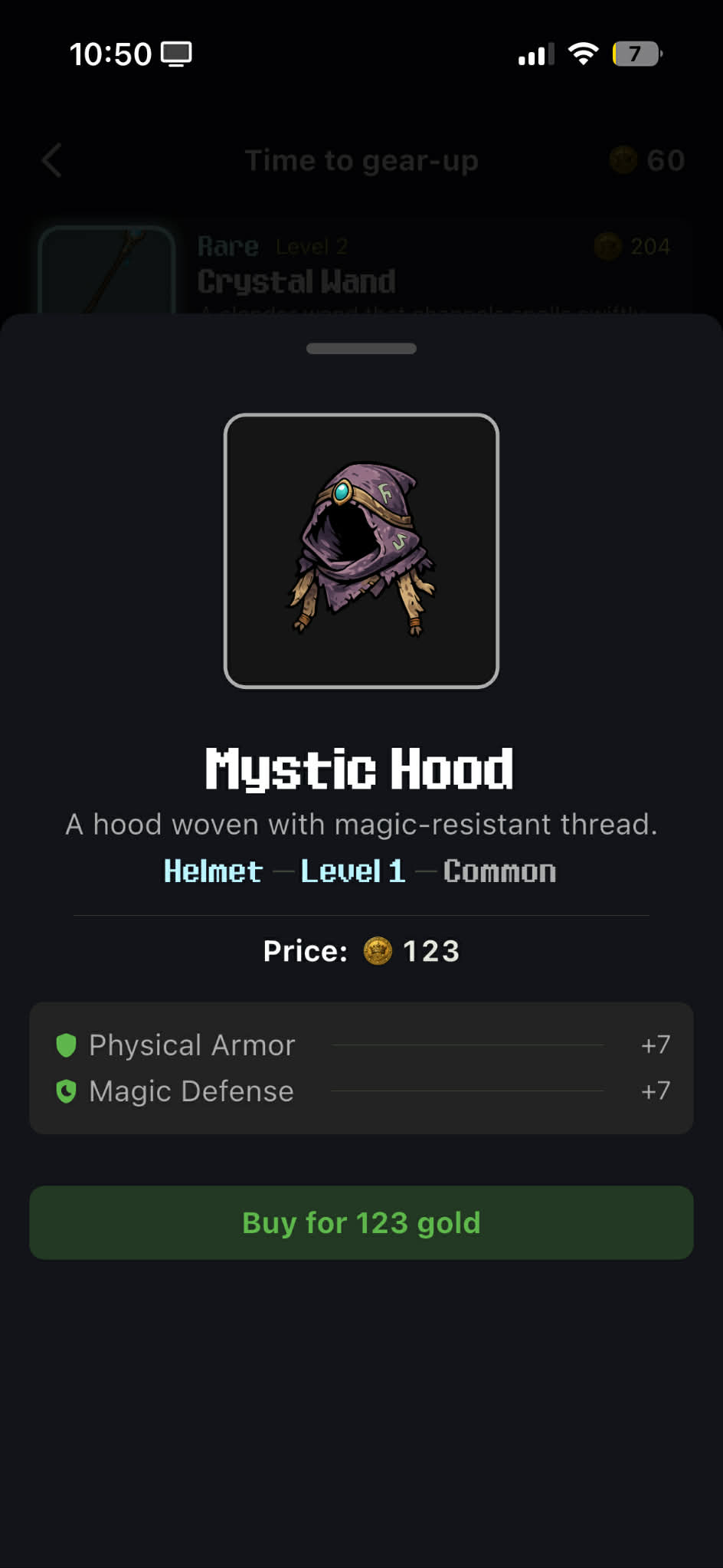
- Armor, Magic Defense, and Speed are shown in the UI multiplied by a display factor (each raw point has a big downstream effect on combat, so showing the raw number would look small compared to Attack Power's point values).
- The combat engine uses the raw internal numbers; the display math is purely a UI presentation choice.
What this means in practice: an item tooltip saying "+7 Speed" represents a smaller raw Speed value than, say, "+7 Attack Power" - but the Speed is doing more per-point than the raw number implies.
Stats Stack Additively
When you equip an item, its stats add to your existing combat sheet linearly. Two items that both give +5 Attack Power add up to +10 Attack Power - there's no diminishing returns, no stacking penalty. You can stack in whatever direction you want.
Combat-effect caps (physical DR, magic DR, dodge, crit) still apply to the derived number, but the underlying attribute contributions stack normally.