
Dungeons Overview
A dungeon is the climactic boss fight at the end of a premade goal's journey. After you've spent days, weeks, or months working through the goal's sub-goals, tasks, and infocards, the dungeon is the payoff - a curated encounter where the soldiers representing your adopted habits fight their way through a lineup of monsters to reach a boss.
What a Dungeon Is
A dungeon ties two systems together:
- The goal supplies the unlock. You can't enter the dungeon until the goal is complete. Everything that made the goal feel like a journey - sub-goal wins, infocards read, tasks ticked off - is what gates the dungeon's door.
- Your habits supply the party. The dungeon's required habits are the ones you must have adopted and kept alive. The soldiers those habits produced are the party you take in.
This is what makes dungeons feel like a motivational payoff rather than a minigame. Your real-life engagement during the goal shapes how strong your party is the day the dungeon unlocks.
Dungeons Are Premade, Not Custom
Dungeons exist only for premade goals. Custom goals never have a dungeon.
The asymmetry is deliberate: a dungeon requires a hand-authored combat payload - a monster lineup, a boss, a theme, required habits, balance tuning - that only makes sense when designed alongside the goal it caps. A user-built goal has no equivalent content to tune against.
Entering a Dungeon
The path is short once everything's in place:
- Complete the premade goal the dungeon is attached to.
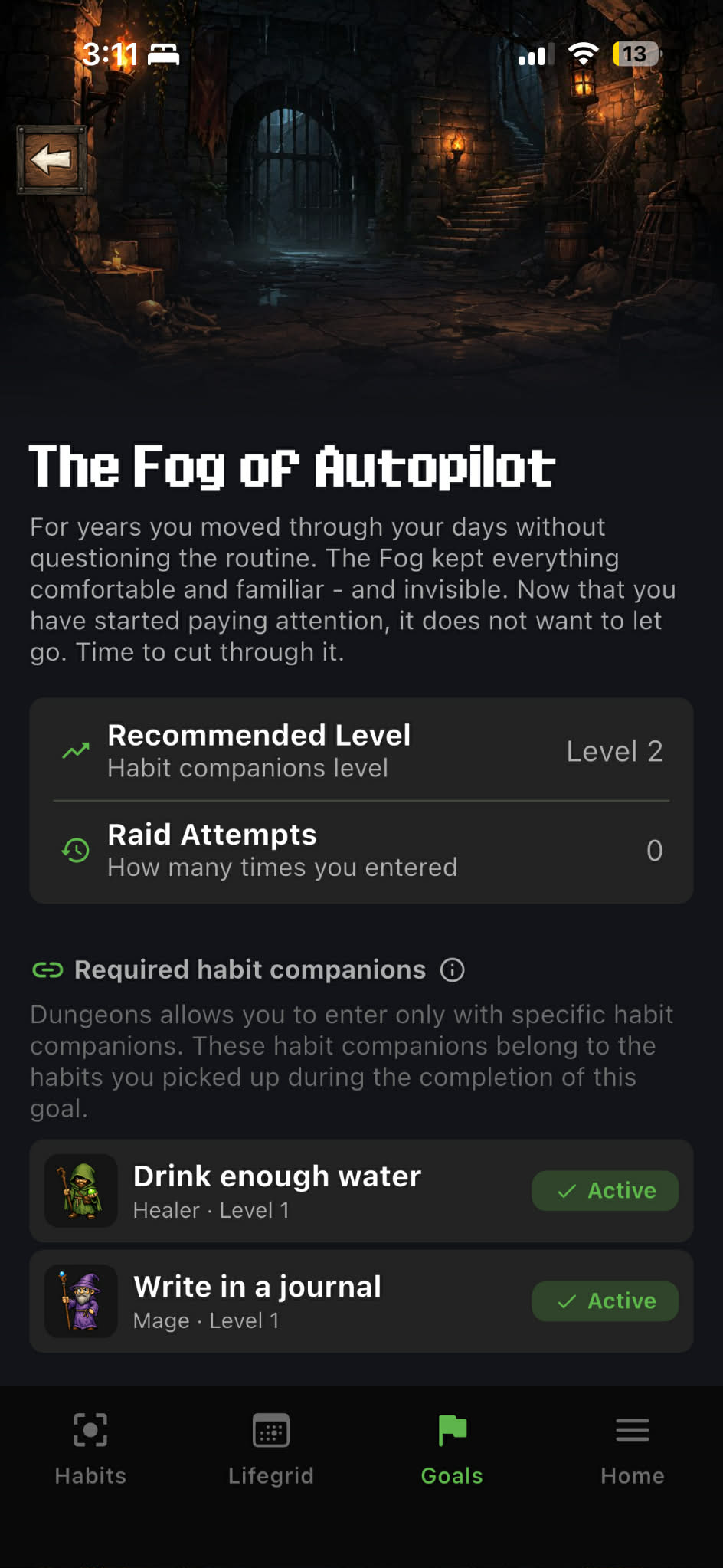
- From the goal's detail page, tap through to the dungeon detail page.
- Confirm all required habits are adopted with living soldiers attached.
- Assemble your party - required soldiers fill mandatory slots automatically; you pick optional soldiers from habits linked anywhere in the goal's tree.
- Enter the fight.
Once you start, the full run plays out - soldier encounters first, boss phase last. No mid-run checkpoints, no saves.
Party of Up to Three
Your party is your avatar plus up to three soldiers. The avatar always participates. The three soldier slots are filled in order:
- Mandatory: the dungeon's required habits.
- Optional: any other good habit linked to the goal or its sub-goals.
Bad habits, unrelated habits, deleted habits, and habits without a soldier are never eligible. See Party Selection.
Difficulty Signal
Each dungeon exposes a single user-facing difficulty hint: a recommended level, drawn from the dungeon's regular (non-boss) monster lineup. Compare it to your party's soldier levels on the same page - a party below the recommended level probably needs more habit engagement before attempting; a party at or above is in reasonable shape.
The boss itself scales dynamically to your level, so the boss isn't the bottleneck for "am I strong enough?" The regulars are.
No Mid-Run Checkpoints
A dungeon run goes from the first encounter all the way through the boss phase as one continuous unit. If you forfeit or lose encounter 3, the retry starts from encounter 1. The whole run is supposed to feel like a single test, not a series of save points.
Rewards on First Clear
Clearing a dungeon the first time pays out:
- Gold scaled to your level.
- A guaranteed item drop at Rare or better.
- The goal's
dungeonClearedflag flips on permanently. - Any matching achievements trigger.
Re-fights are allowed, but repeat runs pay reduced rewards - the first-clear payout is one-time.
Why one-time rewards
The dungeon is a climactic moment tied to the goal's completion. Letting repeat clears pay the same gold as the first would turn it into a grindable income source - and defuse the sense that finishing the goal meant something. Re-fights are permissive; re-rewards are not.
Defeats Don't Punish
Losing a dungeon costs nothing material. No gold lost, no items lost, no damage to your soldiers' actual levels. The only cost is time - you'll need to run the dungeon again from the start. Retry is always available as long as the required habits are still satisfied.