Bosses
A boss is a monster placed into an encounter with the boss flag set. That single flag changes almost everything about how the monster behaves at runtime - it uses a different scaling regime, loses access to its special skills, loses its AI, and fights in a one-on-one arena instead of a squad.
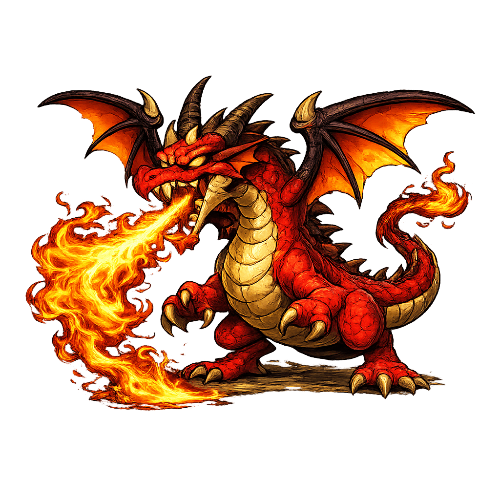
Regular Monster vs Boss - Side by Side
| Aspect | Regular Monster | Boss |
|---|---|---|
| Reference for stat scaling | Level-matched soldier without equipment | Level-matched avatar with equipment |
| Scaling curve | Consistently lower than player units at same level | Climbs aggressively - at high levels, exceeds player baseline |
| Skills | Basic attack + 1 special | Basic attack only - no special |
| AI | Scoring AI with class personality | No AI - always basic-attack |
| Combat phase | Soldier phase (squad vs squad) | Boss phase (avatar alone vs boss) |
| Fights against | Your party of avatar + soldiers | Your avatar only |
| Damage pipeline | CTB with skills, charges, status effects | Auto-battle - strict alternation, basic attacks |
See Boss Phase Overview for the full rules of the fight mode.
What Makes a Boss Different
Three design choices define a boss:
1. Scaled Against a Geared Avatar
Boss scaling assumes the player has some level-appropriate gear. A level-1 boss is tuned against a nearly-naked avatar (you've just started, you haven't had time to acquire equipment), but by mid-game the assumption is that you have partial gear, and late-game bosses assume a full equipment loadout.
This means a player who's been ignoring the equipment system will find bosses harder than expected, and a player with well-earned gear will find them fair. The scaling is honest about equipment expectations - it doesn't check your actual loadout, it scales as if you have the expected one.
2. No Special Skill
Regular monsters carry one special skill on top of their basic attack. Bosses don't. A boss's entire combat kit is its class basic attack, used every turn.
Why bosses lose their specials
The boss fight is already stripped of skills on the player's side too - the avatar uses basic attacks only, enhanced passively by class perks. Adding enemy specials on top would make the fight noisy for a phase that's supposed to be a clean build check. Keeping both sides on basics produces a fight where the only variable is what each side has built into their basic attack (class perks, stats, equipment).
3. No AI Decisions
Regular monsters use a scoring AI to pick each turn's action from a list of candidates. Bosses don't. A boss has exactly one action available - its basic attack against the avatar - and no choice to make.
This moves all the decision-making onto the player. The boss is a deterministic damage timer; your build is what determines whether the timer runs out on you first or on the boss.
Boss Stat Profile
A boss's actual combat numbers come from:
- The archetype (a specific monster in the catalogue) and its stat weights.
- The level (authored on the encounter placement, or the player's level at activation time for adventure quests).
- The balance ratio - less than 1.0 at low levels, ramping up to exceed 1.0 in endgame.
- The power scalar - a per-placement tuning knob that lets designers nudge a specific boss harder or weaker.
The end result is a boss that feels like a boss - tougher than any single regular monster at the same level, designed to be a meaningful obstacle.
Dungeon Bosses vs Adventure-Quest Bosses
Both types use the boss-phase model, but they differ in how the boss is chosen and scaled:
- Dungeon bosses are hand-authored by the dungeon's designer. They're scaled to a specific level set on the encounter and tuned to match the dungeon's theme.
- Adventure-quest bosses are picked dynamically from the monster catalogue. The boss scales to your avatar's level at activation time - leveling up during the timer doesn't change the boss.
Shamans Never Appear as Adventure Bosses
On the adventure board, Shamans are excluded from boss selection entirely. Their support-focused stat profile - intentionally weak attacks, defensive skills - produces trivially easy 1-on-1 boss fights that don't feel climactic.
Shamans can still appear as regular monsters in multi-phase adventure quest soldier phases, where they function as intended support units. Just not as bosses.
Dungeons are hand-authored, so dungeon encounter design handles this directly - if a dungeon boss is a Shaman, the designer made that choice deliberately.
What a Boss Isn't
To ground expectations, bosses deliberately don't include a few things you might expect from boss content:
- No multi-phase transformations. A boss doesn't change mid-fight at an HP threshold.
- No enrage mechanics. A boss at 10% HP fights the same way as a boss at 100%.
- No boss-only abilities or immunities. Damage types work normally.
- No boss-specific party requirements. Beyond the dungeon's required-habits list, there's no "you must bring a Healer" rule.
The whole design intent is that bosses are bosses because the numbers are bigger, not because the rules change.